Myocardial involvement has been recognized as an early manifestation of COVID-19 infection relative to other members of the coronavirus family, with studies indicating that up to 30% of COVID-19 patients may experience irreversible myocardial involvement (
16-
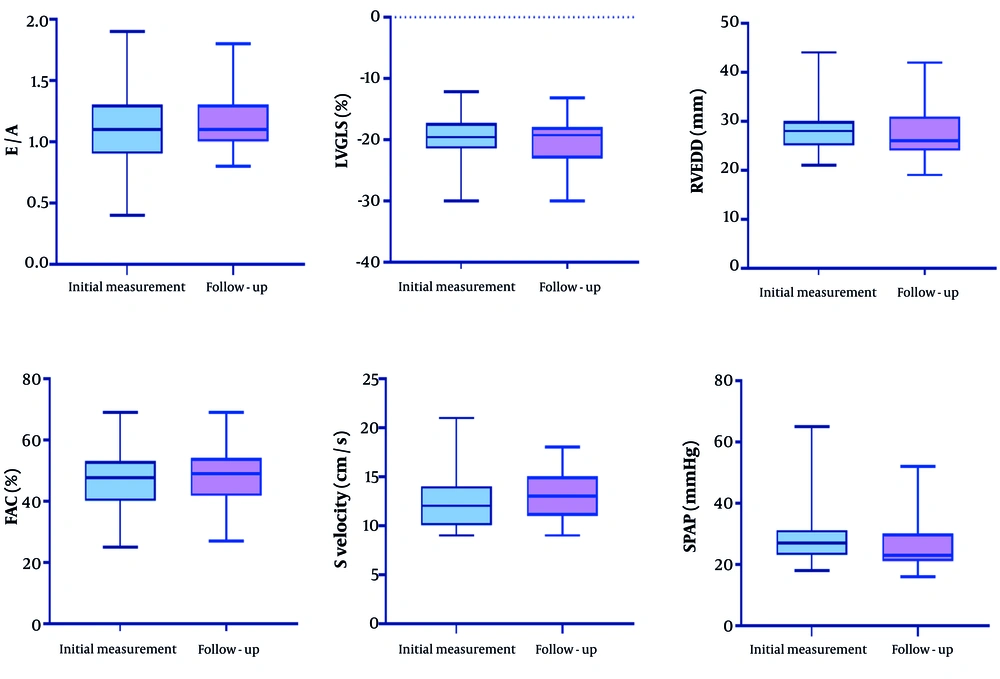
20). In our study, initial echocardiography findings showed that while LVGLS was slightly decreased and SPAP was slightly increased, other parameters remained within normal ranges. This suggested that 2D speckle-tracking echocardiography (2D-STE) could be more beneficial than traditional echocardiographic parameters for evaluating the patients. The comparative analysis of echocardiographic findings between the initial examination and follow-up conducted two years later revealed significant improvements in E/A ratio, LVGLS, RVGLS, RVEDD, fractional area change (FAC), S-velocity, and SPAP. These changes likely indicate recovery from the acute myocardial injury sustained during the initial illness. Our findings regarding LV and RV volume and function during hospitalization for COVID-19 were consistent with other echocardiographic studies, which have demonstrated that absolute values of LVEF, E/e' ratio, TAPSE, and RV S' typically remain within normal limits, while GLS decreases during hospitalization (
10,
21,
22). This pattern of "reversion to the mean" likely resulted from the resolution of the physiological stress response in acute patients. Our results provide valuable insights into the prevalence of cardiovascular sequelae following SARS-CoV-2 infection among patients who required hospitalization and survived for two years post-discharge. Previous studies have indicated that LVGLS was more sensitive in detecting subtle changes in LV function compared to LVEF (
23). This finding aligned with our cohort, where LVGLS exhibited a significant decrease over time, despite initially normal LVEF. It has been hypothesized that LVEF may be affected by the presence of myocardial dysfunction but is also load-dependent (e.g., influenced by hypovolemia), while GLS may better reflect myocardial dysfunction and various aspects of the cardiac response to sepsis (
24,
25). A study by Lassen et al. found that echocardiographic measures of RV function and cardiac biomarkers improved after resolution of COVID-19 infection, while LVEF showed a decrease post-recovery without a significant difference from LVEF in acute COVID-19 patients. They reported that GLS remained unchanged after recovery, and recovered COVID-19 patients exhibited lower GLS, TAPSE, and RVLS than matched controls, while still within clinically acceptable normal ranges (
26). Moreover, a recent study by Moody et al. investigated adverse ventricular remodeling in 79 survivors of COVID-19, finding that 29% exhibited persistent adverse remodeling (
27). However, their study had a significant selection bias since it included only patients who underwent echocardiography due to clinical complications during hospitalization. This selection likely accounts for the higher rates of cardiac complications observed in their population. Conversely, Catena et al. conducted echocardiographic examinations in 64 patients previously hospitalized for COVID-19, approximately 41 days after discharge, concluding that there were no abnormalities or evidence of persistent cardiac dysfunction (
28). Unfortunately, they did not have acute infection data for comparison and lacked a non-COVID-19 control group. Furthermore, their study did not employ STE analysis to detect more subtle myocardial changes.
In agreement with our findings, several studies have emphasized that despite a slight decrease in LVEF, TAPSE, RVLS, and GLS, all metrics remained within normal ranges and clinically acceptable values. The clinically significant decrease in cardiac function observed did not warrant any clinical intervention. However, it is important to note that subclinical changes in myocardial function have been associated with poorer long-term prognoses in various studies, and the evidence for intervention based on these subclinical changes remains lacking (
26,
29). Our results also align with findings from smaller studies using cardiac magnetic resonance imaging (cMRI) to assess diffuse cardiac inflammatory involvement in COVID-19 (
30-
32), particularly those reported by Puntmann et al. (
33). Unlike these prior studies, our research demonstrated changes in cardiac function both during the acute infection phase and after recovery. Given that the lungs are the primary target organ for SARS-CoV-2 and considering the high incidence of acute respiratory distress syndrome in critically ill patients, it is hypothesized that the RV may be particularly vulnerable to dysfunction following COVID-19 infection. Prior studies have established RV failure as a consequence of acute lung injury and acute respiratory distress syndrome, as the RV is sensitive to changes in pulmonary vascular resistance. In our study, improvement in RVGLS suggested enhanced lung function from baseline to follow-up. Although echocardiography and cMRI have demonstrated RV dysfunction in COVID-19 survivors (
34,
35), RV strain calculations are recommended as a clinical measure to evaluate RV function in suspected dysfunction scenarios (
36). While our results showed that traditional RV morphological and functional parameters remained within normal ranges, RV strain in COVID-19 patients increased significantly during follow-up. We anticipated the most significant changes in functional parameters would occur between hospitalization and follow-up, which was indeed observed for RVGLS and SPAP. The change in RV S over time is clinically relevant, as the RV S values at follow-up remained normal for all patients. The most considerable difference was noted in GLS, which during hospitalization was associated with elevated inflammatory markers and hypoxia, suggesting that decreased GLS could be secondary to systemic inflammation (
22). Although we did not evaluate inflammatory markers at follow-up, their normalization could explain the trend of improved GLS compared to hospitalization. In a study on a large cohort of 749 SARS-CoV-2 patients, it was observed that RV systolic dysfunction was more common than LV systolic dysfunction. They showed that a large proportion of patients had reduced RV function (
8). While they focused on the performance of TTE in this disease, our study was designed to survey the improvement of parameters in a 2-month follow-up. Our data showed a notable recovery in several measures two years post-hospitalization. This hypothesis was supported by a global survey which showed that imaging changed management in one-third of COVID-19 patients (
9). Our findings implied that, following the resolution of pneumonia caused by SARS-CoV-2, acute RV dysfunction, which may stem from pulmonary pathology-induced increases in RV afterload, may be improved. However, diffuse inflammation that could potentially affect LV function could still linger during the early recovery phase. The exact mechanisms leading to reduced LV myocardial function remain unclear. This reduction may result from direct viral damage to the heart, secondary systemic inflammation, or both (
26).
The strengths of our prospective study design include repeated echocardiographic assessments during both acute infection and recovery phases. Unlike many retrospective studies that select patients based on perceived clinical deterioration, which may bias the prevalence of cardiac dysfunction, our approach allows for a more accurate representation of the cardiac status of unselected consecutive patients. However, our study has limitations. First, the sample size was relatively small, necessitating caution when interpreting sub-analyses. Second, we did not have access to inflammatory biomarkers at follow-up. Notably, patients who died, likely exhibiting the most severe heart dysfunction, were not included in our analysis. Nonetheless, this study provides valuable insights into the role of echocardiography in assessing patients with acute SARS-CoV-2 infection and highlights differences in baseline LV and RV function. Future research should involve comprehensive evaluations of cardiac function concerning echocardiographic changes in larger, multicenter cohorts. Focused assessments of non-invasive, detailed echocardiographic parameters in COVID-19 patients across all stages of the disease are recommended. Additionally, while we considered significant demographic aspects in our analysis, other determining factors, such as medication use, were not accounted for.
5.1. Conclusions
According to our findings, patients recovering from COVID-19 exhibit significant long-term improvements in cardiac parameters. While these improvements were generally within normal ranges, LVGLS and SPAP showed minimal disturbances in cardiac function during the initial examinations. This suggested their potential utility as non-invasive tools for patient assessment. Thus, this study provides valuable insights into long-term echocardiographic changes in COVID-19 patients, indicating potential reversibility of myocardial involvement.