1. Background
Effective coaching in youth sports prioritizes a positive learning environment (1). Sports psychology research explores the use of cognitive-behavioral principles to enhance motor skill acquisition (2, 3). Notably, a review identified a bias towards elite athletes in psychological skills training (PST) research (72% of studies) (4). This highlights the need for research on PST's effectiveness in improving motor learning and performance among novice athletes.
Psychological skills training, also known as mental skills training (MST), involves consistent training in psychological strategies to enhance motor learning, performance, motivation, and overall sports enjoyment (5, 6). Psychological skills training incorporates methods from various sources, including cognitive-behavioral therapy (CBT) (7, 8). It utilizes specific techniques such as self-talk (ST), goal setting, imagery (IG), and attention control (9). Rather, it complements physical, tactical, and technical training to help athletes reach their full potential (10). While PST programs are implemented across various sports, research suggests these strategies are most effective when practiced alongside physical training (11, 12). However, psychological strategies are more basic skills that should be practice during physical training not alone (13).
Meta-analyses demonstrate the effectiveness of PST programs on elite athlete performance (14). However, these studies often employ multi-component interventions targeting multiple psychological skills (5). In contrast, your research focuses on the effectiveness of ST and IG interventions, specifically for novice athletes (9, 15). Psychological skills training programs that use a multi-component format have been used in various sports fields in different age groups. The most common multicomponent interventions are those that use a combination of two or more of psychological strategies (16).
Previous research primarily investigated PST in adult or adolescent athletes, neglecting the crucial early stages of motor learning in novice athletes (17). This gap is particularly evident in Iran, where research has focused on psychological skill profiles and comparisons in elite athletes (18). Additionally, existing research often explores PST for mental health management in athletes with disorders (19) or retired athletes (20).
The Iranian sports community requires continuous PST programs to enable young athletes to learn and internalize these skills during their development. Mental training integrated with physical training plays a vital role in talent development. This study aims to contribute to this critical area by investigating the effectiveness of ST and IG interventions on motor learning in novice athletes. Most importantly, previous studies were focus on adults' athletes and adolescence athletes was neglected (16). Adolescence is a crucial stage for personality development, offering a window where psychological interventions may be more impactful than in other age groups due to the ongoing development of the frontal cortex (21). Personality traits significantly influence performance in various situations, including motor skills (22). Notably, adolescence is a distinct phase of neurodevelopment with unique characteristics in cognitive, emotional, and physical processes compared to adulthood (23, 24). Therefore, it is not surprising that adolescent learners, in comparison to learners who have advanced in terms of growth and development, institutionalize psychological skills in their personality and behavior (2). Research suggests that adolescent learners are more likely to integrate psychological skills into their personality and behavior compared to older athletes. Therefore, the design and implementation of multiple psychological interventions in adolescence novice athletes is important.
2. Objectives
Therefore, the present study examined the effect of a PST course on the acquisition and retention of simple volleyball serve among adolescent girls.
3. Methods
3.1. Subjects
A priori power analysis, conducted using G*Power 3.1 software, indicated that a minimum of 44 participants (n = 11 per group) was necessary to detect a moderate effect size in analyses of variance (ANOVA) with repeated measures, with specified parameters including the α-error = 0.05, power = 0.8, four groups, three measurements. Then, 60 adolescent female novice volleyball players in public School in Tehran (Iran) were recruited to participate in the current study. he eligibility criteria comprised (1) female novice participants in volleyball; (2) aged between 12 and 15 years; (3) expressing willingness to adhere to the study protocol; (4) exhibiting normal vision based on the Snellen chart test and having no apparent neuromuscular, motor, or sensory disorders; (5) lacking prior exposure to IG or ST training; and (6) obtaining written informed consent from parents. Participants and their parents received comprehensive information regarding the study's objectives, procedures, and the confidential handling of anonymous data. Subsequently, both participants and their parents provided written consent for participation.
3.2. Apparatus and Task
3.2.1. Assessment of Volleyball Serve Skill Performance
The AAHPERD Volleyball Serve test (1984) was used to evaluate the correctness and precision of volleyball serve skills. Using the scores of this test, the pre- post-tests and retention scores were then calculated. This test has acceptable validity and reliability (80%). Based on test instructions, one half of a volleyball court was divided into four sections and points 1 to 4 were marked. Then, a test was carried out, during which each subject was requested to perform 10 volleyball serves. The mean score of 10 volleyball serves was considered as their score. Net balls, side outs and out-of-bounds, other than causing a loss of points, also led to a reduced turn of ten times. The balls landing on the end line earned the highest scores (25, 26).
3.3. Procedure
The participants were randomly allocated to one of four group: (1) ST, (2) IG, (3) a combination of ST and IG (ST+IG), or (4) control (involving similar physical training without ST or IG). Randomization involved the creation of a computer-generated sequence of random numbers. Tickets were sequentially numbered, placed in a ballot box, and drawn by an independent researcher not directly involved in the study. Once selected, a ticket was set aside. The present study included pre-test, post-test and retention stages. After completing and recording the scores of the pre-test stage, the acquisition stage (intervention) was done in 24 sessions and in each session 60 trial were made in the form of six groups of ten attempts.
In the ST group, the participants were asked to use the key words "wrist" (as a reminder to be in plantar flexion when striking the wrist), "angle" (as a sign to choose the angle first) and "goal" (as a hand signal to go to the goal with all the strength. In the IG, the participants were asked to visualize the volleyball serve skill for 15 minutes in a quiet place before starting the training sessions and then perform the training session. In the ST + IG group, the participants were asked to visualize the volleyball serve skill for 15 minutes in a quiet place before starting the session, and then before each trail, the key words "wrist" (as a reminder that when the wrist is in plantar flexion during the impact), repeat the "angle" (indicating that he chooses the angle first to serve) and "goal" (indicating that the hand goes towards the target with all its strength). In the control group, the participants performed 60 volleyball serves in each session without any instructions. After the last training session, the post-test stage was conducted, where the participants performed 10 simple volleyball serves. The retention stage was done two weeks after the last training session.
3.4. Data Analysis
Mixed 3 * 4 ANOVA was used. Following, a one-way ANOVA was utilized to compare groups at each phase and one-way repeated measure to assess the impact of each intervention from pre-test to retention. The data analysis was performed using SPSS version 22 software, with the level of significance set at P ≤ 0.05.
4. Results
As highlighted in Table 1, the mean and standard deviation of the participants' volleyball serve scores are different in measurement stages of the study. The results of the mixed ANOVA indicated the main effect of time, group and the interaction of time * group were significant (Table 2).
Table 1.
Mean ± Standard Deviation of the Volleyball Serve Score of the Participants in Different Stages of Measurement a
| Groups | Pre-test | Post-test | Retention |
|---|---|---|---|
| ST | 5.80 ± 2.17 | 9.86 ± 2.19 | 8.18 ± 2.02 |
| IG | 6.10 ± 4.88 | 9.33 ± 2.09 | 8.06 ± 2.73 |
| Combination | 6.73 ± 2.21 | 12.53 ± 2.29 | 10.30 ± 2.19 |
| Control | 5.73 ± 2.37 | 7.66 ± 1.75 | 6.20 ± 1.19 |
Abbreviation: ST, self-talk; IG, imagery.
a Values are expressed as mean ± SD.
Table 2.
The Results of Mixed ANOVA with Repeated Measurements for Volleyball Serve Skill
| Source | Sum of Squares | df | Mean of Squares | F | P | Eta Squares (η2) |
|---|---|---|---|---|---|---|
| Time | 407.08 | 2 | 203.04 | 25.19 | 0.001 | 0.57 |
| Group | 132.09 | 3 | 44.03 | 11.50 | 0.001 | 0.38 |
| Time × group | 61.90 | 6 | 10.15 | 3.90 | 0.013 | 0.21 |
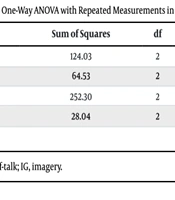
The results of the ANOVA with repeated measurements for each group showed that ST, IG, ST + IG, and control groups has a significant improvement on the performance and learning of simple volleyball serve skills (Table 3). Also, between group comparison showed there is no significant difference between the groups at the pre-test [F (3) = 0.74, P = 0.53, η2 = 0.038]. Moreover, there is a significant difference between the groups in the post-test [F (3) = 13.19, P = 0.001, η2 = 0.42] and retention [F (3) =25.19, P = 0.001, η2 = 0.57]. The results of Tukey's post-hoc tests revealed that the combination group significantly outperformed the ST, IG, and control groups in both the immediate post-test and the retention phase. The ST group also significantly outperformed the control group in both phases.
Table 3.
The Results of the One-Way ANOVA with Repeated Measurements in Each of Group
| Groups | Sum of Squares | df | Mean of Squares | F | P | Eta Squares (η2) |
|---|---|---|---|---|---|---|
| ST | 124.03 | 2 | 62.01 | 19.62 | 0.001 | 0.58 |
| IG | 64.53 | 2 | 32.26 | 13.59 | 0.002 | 0.49 |
| Combination | 252.30 | 2 | 126.15 | 54.17 | 0.001 | 0.79 |
| Control | 28.04 | 2 | 14.02 | 5.20 | 0.039 | 0.27 |
Abbreviation: ST, self-talk; IG, imagery.
5. Discussion
The key finding of the present study was that the combined intervention, incorporating ST and IG, had the greatest positive impact on volleyball serve performance and learning, followed by ST and then IG alone. This result is in line with the previous studies (26-28) and confirms the principle of the law of practice, which shows a significant improvement in the performance of novices at the beginning of practice (29). In the same vine, Theodorakis, Hatzigeorgiadis (28) found that ST intervention facilitates the performance by starting the desired movement through focusing attention, and implementing the correct strategy and technique. ST focuses on improving attention and technical, tactical, or sensorimotor aspects of motor task (26) and is a valuable learning strategy that can accelerate motor skill development, improve performance quality, and foster self-confidence and self-regulation in learners (30). Self-talk as a learning strategy enhances learners' ability to selectively attend to relevant cues during motor skill acquisition. It also empowers learners to self-regulate their movements and utilize feedback to improve their performance and motivation (30). Moreover, ST allows learners to be more flexible and creative in solving subsequent movement problems (27).
The present study also showed that IG intervention with an effect size of 0.49 improved the performance and learning of the volleyball service of adolescent girls. This finding is according to the opinion of cognitive researchers such as Schmidt, Schmidt et al.(29) and Magill and Anderson (31). Therefore, the use of IG allows to review the symbolic components, understand the movement pattern, and encode the required movements in connection with the execution of motor skills in the brain and the creation of the movement program in the central nervous system (29). In explaining this finding, Morris, Spittle (32) introduced the creation of a model in the central nervous system as the reason for the effectiveness of IG. According to his explanation, imagining an action is similar to when that action is actually performed. On the other hand, by passing through the cognitive stage, movement factors become more important, since mental IG involves both cognitive and movement elements, it seems to be useful both in the early stages of training and in the later stages. The results of the present study on the superiority of IG over physical training prove this fact. Moreover, Morris, Spittle (32) claimed that effectiveness of mental IG is based on both thinking about a skill and also an image or model is created in the central nervous system of how to perform the skill. This issue is similar to Anderson's theory about the development of informative knowledge and against Keil's theory about creating a movement program by developing a skill pattern (29). Holper and Wolf (33) considered the effectiveness of IG training combined with physical training as compared to physical training only for the reason that mental IG training efforts work like physical training efforts without information feedback. Studies (29, 31) have shown that reducing the relative frequency of augmented feedback or awareness of knowledge of result (KR) and leaving it in one part of the efforts increases motor learning compared to training with KR after each effort.
Another finding of this study indicated the better performance of the combined group (IG + ST) with an effect size of 0.79 compared to ST and IG only and control groups. Mental IG along with ST, as it involves both psychological factors and cognitive elements in learning, leads to higher learning. This finding might be interpretation with neurosciences studies that showed through IG, the use of the right hemisphere of the brain in relation to the information that we see and feel or focus on, causes improvement in learning (32). Furthermore, researchers emphasize the role of ST in the initial stage of learning and helping the problem-solving process. Imagery is also effective in preparing a learner to perform and helping to perform a well-learned skill. In this approach, a learner imagines his/her successful performance through mental training, and in this case, mental training combines the characteristics of both acquisition and performance situations, and ultimately facilitates storing the action in retention.
Therefore, it is suggested to the trainers to use combined psychological strategies in the training of motor skills. It is also suggested that in future research the role of these interventions should be considered according to skill level (beginner and professional), type of skill (simple and complex), gender considerations (male and female) and examination of the qualitative pattern of skills (kinematic and kinetics) to be investigated.