
1. Background
Various scientists are currently making attempts to find the best teaching method in physical education. Recently, motor learning scientists have shifted their focus to linear (LP) and differential (DL) pedagogy methods (1, 2). LP stems from a cognitive perspective, emphasizing the role of the brain in learning, while DL originates from the perspective of ecological dynamics, considering the equal influence of the person, the environment, and the task on learning (3, 4). A review of the background suggests that DL is more effective than LP in enhancing sports performance (5-9). However, it remains unclear whether pedagogy content knowledge (PCK) related to DL in the trainer can also improve the learners' performance compared to LP.
Pedagogy content knowledge refers to the knowledge that allows a trainer/teacher to adapt their knowledge to meet overall needs (10). Empirical studies have shown that PCK can enhance instructor knowledge and learner performance. In a study the impact of PCK on performance, students were divided into four groups. The coach initially taught volleyball skills to two groups, then participated in a PCK workshop and continued teaching the other two groups. The results indicated that the students' performance improved after the workshop compared to before. Additionally, the instructor utilized a variety of assignments, small field games, and verbal skills more frequently after the workshop (11). Similarly, in a study by Iserbyt et al. (12) focusing on crawl, a similar design was implemented. The findings revealed that participation in the PCK workshop enhanced students' performance and improved the teacher's teaching behavior. In another study by Iserbyt et al. (13), a teacher taught badminton to two different groups before and after participating in a PCK workshop. The results demonstrated improvements in both the coach's behavior and the athletes' performance after the workshop. In a study by Iserbyt et al. (14), the performance of three teachers and their 66-teaching knowledge were compared before and after participating in a PCK workshop. The results showed enhancements in both the teachers' behavior and the students' performance after the workshop.
It appears that DL and PCK are related because both emphasize the role of dynamics in training (12). In DL, adaptability and flexibility are highlighted (15), aligning with PCK, where the trainer adjusts their knowledge to the learners' characteristics and modifies their teaching method moment by moment to achieve the best results (16). Therefore, it seems necessary to utilize DL methods based on the results of studies and their application in physical education. However, despite the studies conducted, the specific type of workshop training content is not clear in the studies presented.
2. Objectives
Therefore, the aim of this study was to examine the impact of LP and DL pedagogy content knowledge on athletes' performance and coaches' knowledge in breaststroke.
3. Methods
3.1. Subjects
The participants in this study included one teacher (42 years old with 20 years of experience teaching physical education) who was purposefully selected, and 45 physical education students who voluntarily took part in the study. Three learners from G2 (n = 2) and G3 (n = 1) did not participate in the post-test, so data from 15 subjects in G1, 13 subjects in G2, and 14 subjects in G3 were analyzed. Our criteria for selecting a teacher were: (1) his agreement to participate in the research; (2) his interest in learning about new teaching methods in physical education; (3) his ability to teach swimming; (4) his lack of familiarity with DL; (5) being male; (6) being a physical education student; and (7) having knowledge of swimming without being a professional swimmer.
The selected students were volunteers who were preparing to participate in a lifeguard course. These students did not take part in any practical physical education classes or other sports outside of the study. This was confirmed through daily reports from the participants.
3.2. Procedure
We utilized a quasi-experimental design with 3 groups, each consisting of 15 participants. Participants were required to be present at a specific pool on a designated day for a performance assessment, both at the beginning and after a familiarization session. During the pre-test session, all participants were evaluated on two criteria: The number of strokes during a 100-meter breaststroke and their personal record, as seen in previous studies (12). The pre-test was administered by one of the authors, who then categorized the learners into weak, medium, and strong groups. Each group (G1, G2, G3) consisted of 5 participants from each category.
The training period spanned ten days (12), with participants engaging in daily practice sessions lasting an hour and a half. Each session included warm-up (approximately 20 minutes), training (around 50 minutes), and free practice (about 20 minutes). In the first and second weeks, group 1 (G1) underwent training without specific instructions given to the coach, focusing solely on improving breaststroke performance based on initial assessments. A similar test to the pre-test was conducted on the final day of training and recorded.
Subsequently, the coach attended an LP workshop (1) designed and approved by 6 professors and 6 swimming experts, lasting 6 hours with a balance of practical and theoretical components. Following this workshop, group 2 (G2) was trained according to LP-PCK principles, with a post-test conducted. Finally, the coach attended a DL-PCK workshop and trained group 3 (G3) accordingly, with a post-test conducted as well (17).
The information provided to the trainer, using both LP and DL methods, was consistent with the principles of each approach. In the LP, the trainer could provide feedback, give instructions to participants on how to perform action, with clear goals and a clearly stated path to achieve them (1). In the DL, feedback was not allowed. Instead, the trainer focused on manipulating tasks and the environment through actions without repetition. The goal was clear, but participants had to figure out how to reach it without explicit instructions (17). All workshop materials aligned with previous research (7), and the instructor's performance in both LP and DL courses was regularly evaluated for relevance to the material. Since LP and DL have conflicting principles, the provided knowledge helped the trainer focus on teaching the appropriate principles, and the knowledge presented at each stage had such a profound impact that the instructor no longer used previous material (7). So, it became nearly impossible to rely on previous knowledge.
Teacher performance (i.e., PCK) was evaluated in all classes during the 10-day unit. This performance was assessed based on three areas: Use of language, presentation, and appropriateness of instruction, as outlined in previous studies (16). Throughout the training, the instructor was provided with a microphone to record their voice, and a camera captured all of their activities.
The total number of strokes determined participants’ scores in the 100m breaststroke. In this task, a research assistant counted the number of hand strokes as the participant moved along a specified path. Participants began by placing one hand on the edge of the pool, starting to move upon hearing a whistle, with each hand entry into the water being counted.
The time taken to complete the 100m breaststroke was measured in seconds. Timing commenced with the whistle and concluded when the runner touched the edge of the pool after completing the distance. Five research assistants, each assigned to one learner, used a digital stopwatch (Pro Sport Model P-1069) to record the time.
3.3. Data Analysis
The coach's behavior was reported descriptively. Quantitative data concerning the learners were analyzed using SPSS-24 software. Initially, the Shapiro-Wilk test was utilized to assess the normality of the data. Inferential statistics were conducted using a 2 (test) * 3 (group) ANOVA test. Post-hoc comparisons were made using LSD tests with Bonferroni adjustments for multiple comparisons.
4. Results
The demographic information of the participants is displayed in Table 1. The results of the one-way ANOVA indicated that there is no significant difference between the groups in terms of demographic characteristics (Table 1).
| Variables | G1 (n = 15) | G2 (n = 15) | G3 ( n = 15) | All (N = 45) | One Way P-Value |
|---|---|---|---|---|---|
| Age (y) | 22.41 ± 3.41 | 22.99 ± 2.52 | 22.01± 1.99 | 22.47± 2.64 | 0.22 |
| Mass (kg) | 78.40 ± 4.31 | 81.80 ± 4.99 | 80.06 ± 5.22 | 80.08 ± 4.84 | 0.65 |
| Height (cm) | 179.02 ± 5.41 | 178.41 ± 6.6 | 180.52 ± 6 | 179.31 ± 6 | 0.14 |
a Values are expressed as mean ± SD.
b G1, control group; G2, linear pedagogy group; and G3, differential learning group.
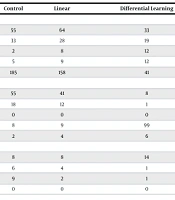
The coach's behavior was reported descriptively, with a total of 980 actions observed during the training. Of these, approximately 39% were found in G1 (386), about 35% (347) in G2, and approximately 25% (247) in G3. The number of actions identified varied depending on the type of training. For instance, feedback was given 158 times in G2, but only 41 times in G3. Constraint’s manipulation occurred 99 times in G3 and 9 times in G2, indicating alignment with the principles of LP or DL. Complete information can be found in Table 2.
Table 2.
The Results of the Coach's Behavior
| Behavior and Behavior Factor | Control | Linear | Differential Learning |
|---|---|---|---|
| Words | |||
| Instructions | 55 | 64 | 33 |
| Description | 33 | 28 | 19 |
| Similes | 2 | 8 | 12 |
| The sign | 5 | 9 | 12 |
| Feedback | 185 | 158 | 41 |
| Visual representations | |||
| Display | 55 | 41 | 8 |
| Partially correct display | 18 | 12 | 1 |
| Wrong display | 0 | 0 | 0 |
| Manipulate constraints | 8 | 9 | 99 |
| Physical assistance | 2 | 4 | 6 |
| Appropriateness of education | |||
| Mature and appropriate | 8 | 8 | 14 |
| Mature and inappropriate | 6 | 4 | 1 |
| Immature and appropriate | 9 | 2 | 1 |
| Immature and inappropriate | 0 | 0 | 0 |
The data related to the students' performance was checked using the Kolmogorov-Smirnov test, and showed that the data were normal (P > 0.05). Descriptive information regarding learners' performance and the number of hand strokes can be found in Table 3.
Table 3.
Descriptive Information for Performance and Number of Strokes a
| Variable and Test | Control | Linear | Differential |
|---|---|---|---|
| Record | |||
| Pretest | 145.8 ± 17.64 | 152.3 ± 9.81 | 14.35 ±18.13 |
| Post test | 140.4 ± 15.79 | 134.3 ± 9.19 | 122 ± 8.55 |
| Number of strokes | |||
| Pretest | 164.2 ± 14.81 | 162.15 ± 13.86 | 167.14 ± 10.28 |
| Post test | 157.2 ± 12.98 | 148.15 ± 11.97 | 135.93 ± 8.65 |
a Values are expressed as mean ± SD.
Record and number of strokes variables was similar between groups at baseline (P > 0.05). The results for record showed that there is a significant for test and a test * group interaction (Table 4). The results showed that there was a significant difference in post-test between the G1 and G2 (P = 0.009). Also, LSD comparisons showed that there was a significant difference in pre to post-test at the G2 (P < 0.001) and G3 (P < 0.001).
Table 4.
The Results of the 3 × 2 ANOVA for the Record Variable and the Number of Hand Strokes
| Variable and Source | Mean Square | DF | F | P-Value | ηp2 |
|---|---|---|---|---|---|
| Record | |||||
| Test | 1449.13 | 1 | 35.77 | < 0.001 | 0.74 |
| Test * group | 180.75 | 2 | 4.46 | < 0.001 | 0.91 |
| Error | 40.50 | 1 | - | - | - |
| Number of strokes | |||||
| Test | 1924.28 | 1 | 28..68 | < 0.001 | 0.61 |
| Test * group | 3870.31 | 2 | 2.62 | 0.007 | 0.76 |
| Error | 1207.37 | 1 | - | - | - |
The results for number of strokes showed that there is a significant for test and a test * group interaction (Table 4). There was a significant difference in post-test between G2 (P = 0.001) and G3 (P < 0.001) compared to G1 group. Also, there was a significant difference in pre to post-test at G2 (P < 0.001) and G3 (P < 0.001).
5. Discussion
This study aimed to investigate the impact of PCK on teacher behavior (words, visual representation, and appropriateness of teaching) and learner performance (record and number of hand strokes). The results indicated that teacher behavior varied based on the teaching method used. Overall, the findings suggested that PCK-DL had a greater influence on both teacher behavior and student performance compared to LP and the control group. This was due to the emphasis on constraint manipulation in DL and the lack of feedback and patterns provided, which was more prevalent than in LP. While LP focused on providing feedback and patterns, participation in the workshop resulted in a reduction in the number of actions performed by teachers. As a result, the total number of actions in G1 was higher than in the other two groups (G1 > G2 > G3). These findings were consistent with previous studies, such as Iserbyt et al. (12). In terms of overall performance, G3 demonstrated better performance in both dependent variables and the post-test compared to the other groups. These results align with the impact of the PCK workshop, as seen in the study by Iserbyt et al. (12), where participation in traditional group and sports training had a positive effect on coach behavior, record, and reduction in the number of hand strokes in swimmers during the 50m breaststroke event.
In explaining the results, it can be said that participation in PCK workshops is beneficial because it helps the teacher/trainer improve their knowledge based on the conditions and characteristics of the learners (16). This knowledge improvement enables the teacher/trainer to use appropriate language for the learners' features, move purposefully in this direction, and avoid unnecessary words and verbal feedback (13, 14). Instead, they can use similes and symbols.
As our results section also revealed, the use of feedback decreased for G2 and G3 compared to G1, while the use of similes increased. Improving the teacher's knowledge helps them consider the unique characteristics of the learners to enhance their performance and design exercises that suit the class's characteristics (16). This helps the instructor adopt a dynamic teaching method. This issue is also highlighted in the perspectives of ecological dynamics (18). Learning and development in this perspective align with the individual's limitations, the environment, and the task. It is emphasized that teachers/educators should decide what to do based on the current conditions (19).
In comparing LP and DL, it can be argued that DL has criticized LP in the realm of skill acquisition. This is because in LP, breaking down the skill into smaller parts hinders the connection of information and movement in a real-world setting (20, 21). However, in DL, the instructor motivates the learner to overcome challenges that arise from limitations (22). There is no one-size-fits-all model for all learners in DL. Instead, the coach guides the learner to acquire and enhance a specific skill by adapting to their unique physical characteristics (22).
The strength of this study lies in the comparison of LP and DL, providing a new perspective on PCK-related studies. Additionally, this study offers a more detailed report on the behavior of the coach/teacher. The main limitation is the selection of one coach/teacher for all three groups, potentially impacting the results. While efforts were made to mitigate this by choosing a trainer with no DL knowledge, future studies should include more control groups.
Overall, the study confirms that workshops enhancing trainer/teacher knowledge can improve their behavior and aid in enhancing learner skills. However, the effectiveness of the coach/teacher's behavior on learner performance can be influenced by the type of training received in these workshops.