


1. Background
Education is the most important element in improving the mental, physical and health conditions of a society (1). Today, the discussion of education has affected all aspects of science, economics, and most importantly health and well-being, and this issue is very important in childhood and in schools. How to teach has been the attention of researchers and scientists for years, and in recent years, with the introduction of inclusive education, in which children with developmental and learning disorders should study alongside normal children, has become more prominent (1).
Today, schools are facing an increasing number of cases of hyperactivity disorder and developmental coordination disorder (DCD), making it challenging to distinguish these children from their peers (2). Hyperactivity is a neurological condition that affects children's movement abilities (3). Additionally, children with DCD exhibit weaker motor skills compared to their peers (4). Both DCD and hyperactive children struggle with low motor competence (2). Motor competence is crucial for both adult functioning and children's health (5). Therefore, it is essential to identify the most effective training methods to enhance motor competence in both typical and disordered children.
Inclusive education aims to support children with disabilities within mainstream schools (6). While traditional education methods have typically been used, non-linear, differential, and game-based learning approaches such as teaching games for understanding (TGFU) have been introduced as effective strategies to complement inclusive education (7). In the non-linear approach, individuals are not given a specific model but instead, the environment and task constraints are manipulated to help individuals discover the desired model (8). The differential method focuses on unique movements to accommodate individual differences (9). Teaching games for understanding incorporates game-based learning, which can be beneficial for inclusive education (10). These methods prioritize individual attention from instructors, making them more effective for integration with inclusive education compared to linear methods (7).
Studies have introduced the TGFU or non-linear method as a better method in the field of education (8, 11). While it is suggested that a combination of non-linear, differential, and TGFU methods with inclusive education can lead to positive outcomes for individuals with disabilities, there is a lack of empirical studies in this area. One of the few studies conducted was by Mohammadi Orangi et al. (12), where the inclusive education method was used in conjunction with linear and non-linear methods. In this study, two hyperactive children practiced motor skills with typically developing children using both linear and non-linear methods. The results indicated that motor skills and self-esteem of hyperactive children improved more in the non-linear group compared to the linear group. A study by Aghdasi et al. (13) also demonstrated that children with DCD benefit more when non-linear education is combined with typically developing children. However, these studies only explored two training methods, highlighting the need to compare multiple strategies to identify the most effective approach.
Although experimental studies have shown the effect of modern training methods for perceived and actual motor competence. However, the use of these methods to combine with inclusive education and choosing the best method among the methods proposed in the studies has been neglected. Perceived and actual motor competence are the basis of fundamental motor skills, which will be effective in improving sports skills, daily activities and psychological factors in the society of normal and disordered children
2. Objectives
Therefore, the aim of this study was to determine which method (linear, non-linear, differential, or TGFU combined with inclusive education is most effective in enhancing perceived and actual motor competence in hyperactive, DCD, and typically developing children.
3. Methods
3.1. Subjects
The statistical population of the study included all primary school-aged children in Tehran, categorized as normal, hyperactive, and those with DCD. A total of 64 children were selected using convenience sampling, with each group consisting of 12 normal children, 2 hyperactive children, and 2 children with DCD. Children with DCD and attention deficit hyperactivity disorder (ADHD) were identified based on DSM-5 criteria, and their diagnoses were confirmed by clinical psychologists and educational specialists. Assessment tools included the Developmental Coordination Disorder Questionnaire (DCDQ) and ADHD rating scales, which were available in the children's school health records. The inclusion criteria for the study were parental consent and confirmation of the child's complete physical and mental health, as documented in their health records. Written consent was obtained from parents prior to the interventions, and the research proposal was approved by the Faculty of Physical Education at University of Tehran.
3.2. Apparatus and Task
The Bruininks-Oseretsky Test-2 was used to evaluate real motor skills. This test assesses the real movement competence of individuals aged 4 - 21 years, consisting of 14 items that include fine and gross motor skills as well as motor coordination. The retest reliability coefficient of this test is reported as 0.86 (14). Internal motivation questionnaire was used to measure perceived motor competence. This questionnaire includes nine questions, with the total sum of the responses indicating a person's perceived motor competence (15). The reliability and validity of this questionnaire in Iran are reported as 0.56 (11). In this study, participants were shown pictures instead of being asked questions, and their perceived competence was assessed (15).
3.3. Procedure
In this study, children practiced futsal skills in four groups (linear, non-linear, differential, and TGFU) for two months. Its own expert trainer practiced each method. The skills practiced in this study included passing with different parts of the foot, dribbling, shooting at the goal with or without a goalkeeper, receiving and shooting or passing and playing futsal in different dimensions of the field.
In the linear method, model presentation and feedback were used. Initially, the skill was described, and then demonstrated by the teacher or a skilled person, and finally, the children were asked to repeat the same skill. When the teacher recognized that the children had made progress, they moved on to exercises that either are more complex or taught another skill, based on the group's average (9).
In the non-linear method, manipulation of the environment and task was used. The teacher did not describe the skill, but a goal was set for the children to achieve as they saw fit. The instructor then considered each learner's performance and adjusted the environment accordingly, without providing models or feedback. Progression from one skill to another was based on individual progress, not group progress (9).
In the differential method, movements were practiced without repetition or description. The skill was described first, and then learners randomly practiced different variations of the skill prepared by the instructor. No movement was repeated in the same way, and feedback was not provided (16).
Finally, in the TGFU method, tactics were practiced in a game-like manner, progressing from simple to complex. The teacher selected the skills and instead of verbally explaining and instructing the child, they practiced the skills through games. The child may not have been aware of the training's purpose, but the coach designed the games to lead to the learning of the desired skills (17). The interventions took place in two months, two sessions per week and each session lasted 90 minutes. Each session included warm-up (about 15 minutes, main exercise 1 hour and cooling down 15 minutes). Pre-test and post-test interventions were conducted with the learners before and after the intervention.
3.4. Data Analysis
Initially, the normality of the data was checked using the Shapiro-wilk test. Demographic characteristics were analyzed with descriptive statistics. To investigate the effect of training and group differences, a 2 (test) × 4 (group) ANOVA test at a significance level of 0.05 used.
4. Results
The descriptive information of the participants is presented in Table 1.
| Groups | Age (y) | High (cm) | Weight (kg) |
|---|---|---|---|
| Linear | 10.27 ± 1.14 | 144.21 ± 7.7 | 55.34 ± 2.33 |
| Non-linear | 10.64 ± 1.28 | 143.9 ± 12.7 | 82.77 ± 2.32 |
| Differential | 9.99 ± 2.69 | 145.1 ± 12.16 | 96.82 ± 1.33 |
| TGFU | 10.01 ± 1.84 | 144.6 ± 11.8 | 11.59 ± 2.33 |
Abbreviation: TGFU, teaching games for understanding.
a Values are expressed as mean ± SD.
b Number of each group is n = 15.
The results for motor proficiency and perceived motor competence showed that the effect of group * time and time was significant P < 0.05 (Table 2).
Table 2.Results of Mixed ANOVA for Motor Proficiency and Perceived Motor Competence
| Variables | Mean Square | DF | F | P-Value | ηp2 | Statistical Power |
|---|---|---|---|---|---|---|
| MP | ||||||
| Time | 648.17 | 1 | 9.755 | < 0.001 | 0.78 | 0.105 |
| Interaction | 948.12 | 3 | 12.618 | < 0.001 | 0.68 | 0.104 |
| Error | 7.444 | 60 | - | - | - | - |
| PMC | ||||||
| Time | 789.324 | 1 | 3.567 | < 0.001 | 0.65 | 0.88 |
| Interaction | 879.214 | 3 | 7.542 | < 0.001 | 0.54 | 0.074 |
| Error | 14.48 | 60 | - | - | - | - |
Abbreviations: MP, motor competence; PMC, perceived motor competence.
The LSD test results for motor competence in the post-test revealed significant differences between the linear and non-linear, linear and differential, and linear and TGFU groups. No significant differences were found between differentiation with nonlinearity, differentiation with TGFU, and nonlinearity with TGFU. For perceived motor competence, significant differences were observed between the linear and non-linear, and linear and TGFU groups. However, no significant differences were found between linear and differential, differential and non-linear, differential and TGFU, and non-linear and TGFU.
A Figure 1 illustrating the average scores of each group in the pre-test and post-test for motor competence (A) and perceived motor competence (B) shows that the non-linear method, TGFU method, differential method, and linear method demonstrated the most progress from the pre-test to the post-test, respectively.
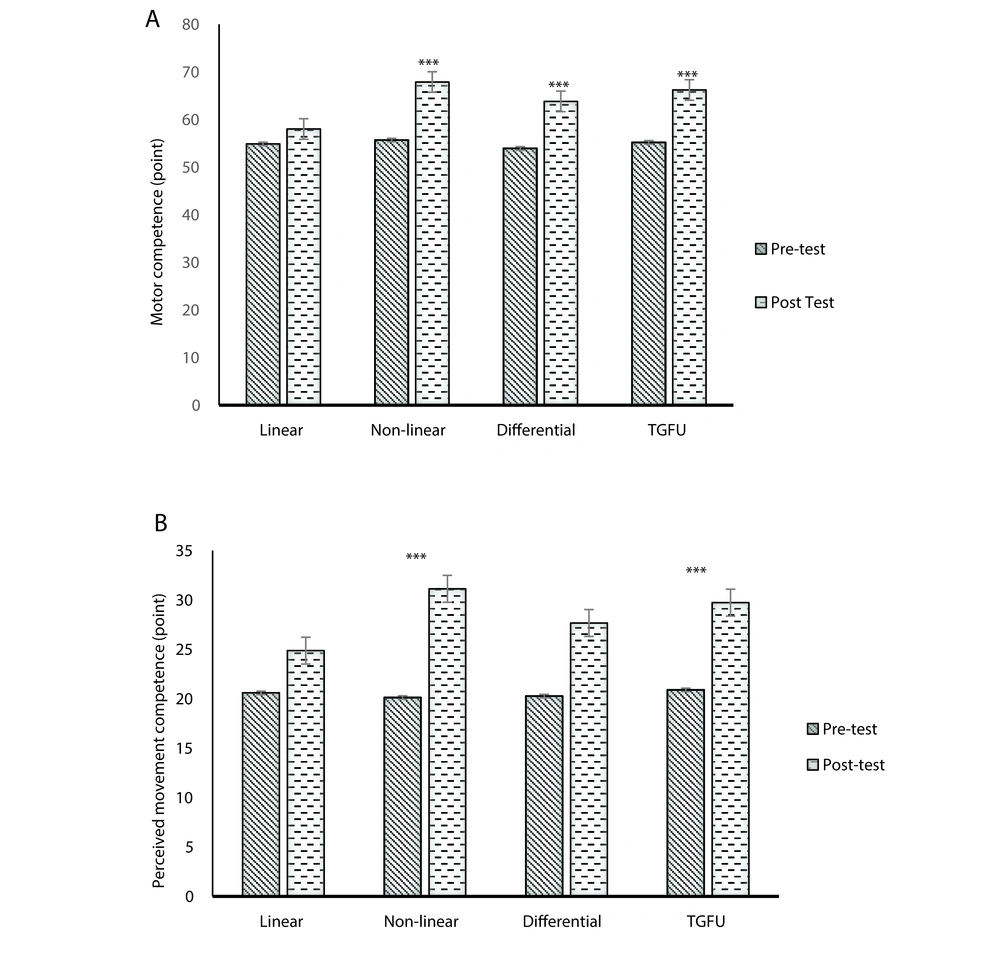
Figure 1.
Changes in motor competence (A); and perceived movement competence (B); from pre-test to post-test in different training groups. ***: Represents the difference with the linear group.
Table 3 displays the scores and percentage changes in the scores of children with ADHD and DCD in each of the training groups. It is evident that children in the non-linear group exhibited the highest percentage of changes in both motor competence and perceived motor competence, while the linear group showed the lowest changes.
Table 3.Scores and Percentage of Changes in the Scores of Attention Deficit Hyperactivity Disorder and Developmental Coordination Disorder Children in Each of the Training Groups
| Variables | Pre-test MP | Post-test MP | Percentage of Changes MP | Pre-test PMC | Post-test PMC | Percentage of Changes PMC |
|---|---|---|---|---|---|---|
| Linear | ||||||
| ADHD | 47.32 | 51.7 | 8.47↑ | 16.08 | 19.92 | 19.27↑ |
| DCD | 45.19 | 49.12 | 8↑ | 19.09 | 24.19 | 21.08↑ |
| Non-linear | ||||||
| ADHD | 44.24 | 52.16 | 15.18↑ | 18.12 | 29.28 | 38.11↑ |
| DCD | 46.62 | 53.63 | 13.07↑ | 22.14 | 33.34 | 23.19↑ |
| Differential | ||||||
| ADHD | 45.52 | 50.42 | 9.71↑ | 23.19 | 29.74 | 22.02↑ |
| DCD | 47.11 | 53.17 | 11.39↑ | 14.64 | 19.11 | 23.39↑ |
| TGFU | ||||||
| ADHD | 49.22 | 55.54 | 11.37↑ | 22.07 | 29.3 | 24.67↑ |
| DCD | 47.16 | 53.09 | 11.16↑ | 20.02 | 28.13 | 28.19↑ |
Abbreviations: MP, motor competence; PMC, perceived motor competence; ADHD, attention deficit hyperactivity disorder; DCD, developmental coordination disorder.
5. Discussion
This study aimed to determine the most effective educational method, in combination with inclusive education, to enhance the motor competence and perceived motor competence of both typically developing children and those with disorders. The results for motor proficiency and perceived motor competence showed that the effect of group * time and time was significant (P < 0.05). Quantitatively, the non-linear method, TGFU method, differential method, and linear method showed the most progress from pre-test to post-test for both typically developing children and children with disorders, respectively. While no previous studies have explored the impact of linear, non-linear, differential, and TGFU methods on both motor and perceived motor competence, the findings of this study align with previous research (12). Recent studies support the application of non-linear pedagogy and game-based approaches in inclusive education (11), indicating positive impacts on motor skill development.
In non-linear, differential, and TGFU methods, individuals have the opportunity to tackle movement challenges independently, without comparison to a group. Training is tailored to individual characteristics, promoting both real movement competence and perception, which is beneficial for inclusive education (18). When comparing the non-linear method with the differential method and TGFU, although these methods share a common perspective, the type of exercises differs, potentially explaining the variations in results observed in this study.
In the results section pertaining to the non-linear method, TGFU method, and differential method, it was demonstrated that the non-linear method is superior to the other two methods in enhancing motor proficiency and perceived motor competence, primarily through quantitative measures. Despite these methods sharing a common perspective, the nature of the exercises differs among them (18). For instance, in the differential method, although it lacks the provision of models and feedback seen in the non-linear method, it involves describing the skill (19). By drawing on the non-linear method, this description somewhat diminishes the element of discovery (20). Additionally, the TGFU method does not involve manipulating constraints or placing the learner in a challenging environment (17). However, these findings did not reach statistical significance, and it is not appropriate to delve further into this study's results due to the short duration of the interventions possibly contributing to the lack of significance. Further investigation in future studies is warranted.
When comparing the TGFU method and the differential method, no prior studies were found in this area, making it challenging to offer a logical interpretation of the results. Nevertheless, it appears that these outcomes could be attributed to children's preference for games over other forms of exercise. Children, as indicated by Hopper et al., tend to enjoy games more and may derive greater benefits from the TGFU method (21). This rationale could also explain the lack of significance in the non-linear method and TGFU comparison.
The other part of the results showed that in both disorder groups, the non-linear group was better than the other three groups. The TGFU, differential, and linear groups had the greatest effect in improving motor skills and perceived motor competence. In explaining this section, it can be said that inclusive education methods place students with special needs alongside their normal peers (22). This approach provides conditions and facilities for creating equal educational opportunities, strengthening social communication, promoting self-esteem and motivation for students with special needs, and is very effective in preventing mental and motor problems (22). On the other hand, in the non-linear training method, individual differences are considered. This method seems to be very effective for people with disabilities by designing the environment according to the characteristics of each person. The results of this research confirm the claim of non-linear methods based on independence and exploration in the learner (8). According to the claim of this training method, a person becomes independent by being placed in an exploratory environment, is happy to handle his own tasks, and his self-esteem increases because he is able to be with others. Non-linear methods increase a person's motivation due to exploratory activities, and this makes a person believe that he can handle his own tasks independently (8). According to Stodden et al.'s model, this high self-esteem and motivation lead the child to more physical activity, which in turn improves motor skills and perceived motor competence (23).
One strength of this study was its exploration of a wide range of teaching and inclusive education methods. For future studies, it would be beneficial to consider the duration of interventions more thoroughly.
In general conclusion, the presented materials emphasize the effectiveness of environmental manipulation over direct support for children with disabilities. These findings underscore the importance of adaptive methods that cater to individual learning profiles. Recent literature suggests that non-linear and game-based learning not only foster motor skill proficiency but also enhance psychological resilience among children with developmental disorders.


