
1. Background
Professional socialization is a complex process in which an individual acquires the knowledge, skills, and identities to become a professional and subsequently internalizes the values and norms of group behavior (1). Professional socialization is critical to the fulfillment of nurses' professional roles and the process of professional self-improvement (2). It is an extensive process from being a student to a qualified professional nurse and beyond (3). Nursing schools, clinical learning environments, and students are key components of this process (4). Acquiring professional identity, adaptation to professional roles, and professional commitment, and consequently, improving the quality of patient care are the most important positive consequences of professional socialization of nursing students (5, 6).
Personal factors have been mentioned as facilitators of professional socialization (3), and self-esteem is a key factor in determining personal's behaviors (7), which can predict socialization (8). According to Murk's theory, self-esteem consists of two components of competence and worthiness (9). Higher self-esteem is associated with greater interest and success in developing relationships and greater satisfaction with social relationships (8). Self-esteem is recognized as a coping source when interacting with others by strengthening individual confidence and a sense of inclusion (10). On the other hand, low self-esteem and lack of assertiveness are associated with how socialization is performed (11).
Nursing is a profession that requires a sense of responsibility, precision, and intelligence. Any shortcoming in the training of this group will certainly affect the quality of health services and ultimately, the health of individuals and communities. The main mission of nursing education is to train competent nurses who have the necessary knowledge and skills to provide high-quality nursing care (12). Self-esteem and professional socialization have a profound effect on the level of professional development of the individual, and better understanding is a necessary step in identifying educational strategies to improve education at universities (8). Therefore, due to a large number of nursing students from different cultures, the process of professional socialization must be carefully considered in all nursing education programs.
2. Objectives
The aim of this study was to determine the level of professional socialization of nursing students and its relationship with self-esteem.
3. Methods
This was a cross-sectional descriptive study. The population consisted of undergraduate nursing students of universities of Yazd/Iran. Considering the level of significance of 5% and test power of 80% with the assumption of r = 0.22 (13), the sample size of 160 students was estimated using the related formula. Considering the attrition rate of 10%, 176 questionnaires were distributed among eligible students. Stratified random sampling was performed according to the proportion of students in each university, considering the inclusion criteria. Inclusion criteria were a bachelor's degree in nursing, students studying in the academic year 2019 - 2020, passing at least one semester of clinical internship, and no transfer or guest from other educational universities.
The data collection tool was a questionnaire consisting of three parts: The first part had questions to examine individual-social characteristics, educational background, having a nursing model, having information and interest in nursing before being accepted in this field, and the reason for choosing this field.
Professional Socialization Questionnaire was designed by Bishive Moghaddam et al. (6) and was adopted from a tool developed by Shahim et al. (14) and Chao et al. (15). This 48-item tool consisted of four categories. The total score ranged between 48 and 240 where a greater score indicated higher professional socialization. The content validity of the questionnaire was assessed using qualitative and quantitative methods, which was reported to be favorable. Cronbach's alpha coefficient and ICC of the instrument were 0.92 and 0.94, respectively (6). In the present study, Cronbach’s alpha was 87%.
The Rosenberg Self-Esteem Scale (16) is one of the most widely used tools in this regard. It has 10 two-choice questions (agree and disagree), which items 1, 3, 4, 7, and 10 are positively worded, and items 2, 5, 6, 8, and 9 negatively. Scores ranged from -10 to +10. A score above zero indicates high self-esteem, and a score below zero indicates low self-esteem. This scale has been used in many studies and has demonstrated adequate validity and reliability (17). The internal consistency reliability was confirmed by an estimated α of 0.93 (18).
After data collection, SPSS 16 was used for data analysis. Descriptive statistical methods (mean and standard deviation) were used to describe the data. The normal distribution of data was evaluated using Kolmogorov–Smirnov test (P > 0.05). Pearson’s correlation coefficient was used to determine the relationship between variables. T-test and ANOVA were used to examine differences in professional socialization and self-esteem based on the characteristics of the participants.
4. Results
Of the 176 questionnaires distributed among students, 10 questionnaires were excluded due to being incomplete. Based on findings, the majority of nursing students were female (61.4%) and single (86.7%) with a mean age of 21.53 ± 4.73 years. Also, 51.8% of students were living with their families, and 92.20% were only studying and did not have a job. The majority of the subjects expressed clinical teachers as an educational model (44.8%) and career future (33.50%), as well as mere acceptance in this field (33.00%), were effective factors in choosing the field. Also, the majority of them (63.9%) had information about the field before entering the university (Table 1).
Table 1.
Demographic Characteristics of the Participants
| Variables | Values |
|---|---|
| Age | 21.53 ± 4.73 |
| Gender | |
| Male | 64 (38.60) |
| Female | 102 (61.40) |
| Marital status | |
| Single | 144 (86.70) |
| Married | 22 (13.30) |
| Current student residence | |
| Living with family | 86 (51.80) |
| Dormitory | 74 (44.60) |
| Student house | 6 (3.60) |
| Academic year | |
| First | 52 (31.30) |
| Second | 40 (24.10) |
| Third | 36 (21.70) |
| Forth | 38 (22.90) |
| Being employed while studying | |
| Yes | 13 (7.80) |
| No | 153 (92.20) |
| Role model* | |
| Theoretical teachers | 51 (24.30) |
| Clinical instructors | 94 (44.80) |
| Ward nurses | 50 (23.80) |
| Classmates | 15 (7.20) |
| Factors influencing the choice of nursing b | |
| Acceptance in the field | 77 (33.00) |
| Career future | 78 (33.50) |
| Suggestions from others | 25 (10.70) |
| Interest | 53 (22.70) |
| Having information about the field before entering the university | |
| Yes | 106 (63.90) |
| No | 60 (36.10) |
| Adaptation of the field to the ideas after entering the university | |
| Yes | 66 (39.80) |
| No | 100 (60.20) |
a Values are expressed as No. (%) or mean ± SD.
b Ability to select more than one option
Professional socialization in the majority of the participants (54.80%) was at the moderate level, and the mean professional socialization was 174.87 ± 19.52. Since the number of questions in each dimension is not the same, in order to be able to calculate the weight of each dimension, all scores were converted to a ratio of 100. Thus, the highest mean was related to the field of valuation and knowledge of the profession (73.48 ± 13.97), and the lowest mean was related to the field of management and organizational policies (57.66 ± 11.58). The mean score of self-esteem in students was 5.65 ± 5.10 (Table 2).
Table 2.
Descriptive Data of Professional Socialization and Self-Esteem Variables in the Studied Samples
| Variable | Number of Items | Min | Max | Mean ± SD | Standardized; Mean ± SD |
|---|---|---|---|---|---|
| Valuation and knowledge of the profession | 11 | 28.00 | 55.00 | 43.33 ± 6.14 | 73.48 ± 13.97 |
| Professional skills | 24 | 55.00 | 120.00 | 87.39 ± 10.15 | 66.03 ± 10.57 |
| Management and organizational policies | 10 | 21.00 | 50.00 | 33.06 ± 4.74 | 57.66 ± 11.58 |
| Interpersonal communication | 3 | 6.00 | 15.00 | 11.09 ± 1.87 | 67.41 ± 15.64 |
| Professional socialization | 48 | 117.00 | 240.00 | 174.87 ± 19.52 | 66.08 ± 10.16 |
| Self-esteem | 10 | -10.00 | +10.00 | 5.65 ± 5.10 | - |
The results showed that there was a positive and significant relationship between professional socialization and its dimensions with nursing students' self-esteem (P < 0.05) (Table 3).
Table 3.
The Relationship Between Professional Socialization and Its Dimensions with Self-Esteem
| Variables | Self-Esteem | |
|---|---|---|
| r | P | |
| Valuation and knowledge of the profession | 0.26 | 0.001 |
| Professional skills | 0.34 | < 0.001 |
| Management and organizational policies | 0.24 | 0.002 |
| Interpersonal communication | 0.28 | < 0.001 |
| Professional socialization | 0.34 | < 0.001 |
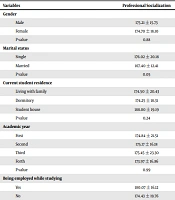
There was a significant relationship between professional socialization and interest in the field (P < 0.001) and the adaptation of the field to perceptions after entering the university (P = 0.008). Regarding self-esteem, this relationship was significant with the variables of acceptance in the field (P = 0.01) and conformity of perceptions with the realities of the field"(P = 0.02) (Table 4).
Table 4.
The Degree of Professional Socialization and Self-Esteem According to Some Demographic Characteristics a
| Variables | Professional Socialization | Self-Esteem |
|---|---|---|
| Gender | ||
| Male | 175.21 ± 15.73 | 6.12 ± 4.69 |
| Female | 174.70 ± 18.10 | 5.35 ± 5.34 |
| P value | 0.88 | 0.34 |
| Marital status | ||
| Single | 176.02 ± 20.18 | 5.45 ± 5.23 |
| Married | 167.40 ± 12.41 | 6.90 ± 4.03 |
| P value | 0.05 | 0.21 |
| Current student residence | ||
| Living with family | 174.50 ± 20.43 | 5.72 ± 5.02 |
| Dormitory | 174.25 ± 18.31 | 5.45 ± 5.34 |
| Student house | 188.00 ± 19.19 | 7.00 ± 3.28 |
| P value | 0.24 | 0.76 |
| Academic year | ||
| First | 174.84 ± 21.51 | 4.80 ± 5.68 |
| Second | 175.17 ± 16.18 | 6.04 ± 4.74 |
| Third | 175.45 ± 23.30 | 5.71 ± 5.76 |
| Forth | 173.97 ± 16.86 | 6.31 ± 4.39 |
| P value | 0.99 | 0.51 |
| Being employed while studying | ||
| Yes | 180.07 ± 16.12 | 5.23 ± 5.68 |
| No | 174.43 ± 19.76 | 5.68 v 5.06 |
| P value | 0.31 | 0.75 |
| Role model | ||
| Theoretical teachers | ||
| Yes | 174.05 ± 17.48 | 6.00 ± 4.64 |
| No | 175.24 ± 20.42 | 5.49 ± 5.30 |
| P value | 0.72 | 0.55 |
| Clinical instructors | ||
| Yes | 175.08 ± 18.55 | 5.61 ± 5.29 |
| No | 174.61 ± 20.85 | 5.69 ± 4.87 |
| P value | 0.87 | 0.92 |
| Ward nurses | ||
| Yes | 173.42 ± 18.36 | 5.32 ± 5.35 |
| No | 175.42 ± 20.11 | 5.79 ± 5.02 |
| P value | 0.54 | 0.58 |
| Classmates | ||
| Yes | 176.80 ± 19.01 | 7.20 ± 2.28 |
| No | 174.81 ± 19.59 | 5.60 ± 5.16 |
| P value | 0.82 | 0.49 |
| Factors influencing the choice of nursing | ||
| Acceptance in the field | ||
| Yes | 171.81 ± 16.44 | 4.85 ± 5.46 |
| No | 177.52 ± 21.58 | 6.33 ± 4.69 |
| P value | 0.12 | 0.01 |
| Career future | ||
| Yes | 172.24 ± 20.26 | 5.10 ± 5.37 |
| No | 177.21 ± 18.64 | 6.13 ± 4.83 |
| P value | 0.10 | 0.19 |
| Suggestions from others | ||
| Yes | 174.08 ± 14.96 | 7.28 ± 5.06 |
| No | 175.02 ± 20.26 | 5.36 ± 5.07 |
| P value | 0.82 | 0.08 |
| Interest | ||
| Yes | 182.54 ± 19.03 | 6.37 ± 3.96 |
| No | 171.28 ± 19.77 | 5.30 ± 5.54 |
| P value | < 0.001 | 0.21 |
| Having information about the field before entering the university | ||
| Yes | 176.94 ± 17.01 | 5.92 ± 4.51 |
| No | 171.23 ± 23.01 | 5.16 ± 6.00 |
| P value | 0.07 | 0.35 |
| Adaptation of the field to the ideas after entering the university | ||
| Yes | 179.80 ± 18.09 | 6.72 ± 4.41 |
| No | 171.63 ± 19.83 | 4.94 ± 5.41 |
| P value | 0.008 | 0.02 |
a Values are expressed as mean ± SD.
5. Discussion
The aim of this study was to determine the degree of socialization of nursing students and its relationship with self-esteem. The results showed that the majority of students had a moderate level of professional socialization. These results are consistent with the findings of Bishive Moghaddam et al. (6). Also, a longitudinal study on nursing students in Taiwan showed that the level of professional socialization of nursing students at the three time points was moderate (19). However, this result is not consistent with some studies (14, 20, 21), in which the level of socialization of nursing students has been reported to be high and desirable. In another study, the mean and standard deviation of the professional socialization score was 46.76 ± 8.96 and was at a low level (22). Differences in the results of these studies can be due to the differences in research populations and the use of different tools in determining the degree of professional socialization, which requires research using the same tools and sample size for better judgment. In addition, cultural and educational differences are other possible causes of this difference.
In the present study, the highest mean was related to the dimension of “valuation and knowledge of the profession” and the lowest mean was related to the dimension of “management and organizational policies”. Consistent with this finding, the results of another study indicated that nursing students in the dimension of “management and organizational policies” were at an unfavorable level (6). Based on the results of the present study, nursing students did not have a favorable attitude toward the organization's management, nurses' authority, recognition of the role of nurses, the proportionality of responsibilities with salaries, and the importance of nurses as capable group in organizational policy. Nursing education programs should be in line with the promotion of the mentioned issues to be able to nurture students who play a professional role in providing services.
The results of the present study indicated the desired level of self-esteem, which is consistent with the findings of other studies (23-27). During the study period, the mental health of nursing students was affected in the face of problems, such as stress, hospital environment, and dealing with patients' problems. Therefore, the programs to maintain students' self-esteem should always be considered.
Our findings showed nursing students with higher self-esteem had a more desirable level of professional socialization. This finding is consistent with the results of Choi and Ha (13). Valizadeh et al. have introduced low self-confidence and lack of professional independence as obstacles to professional socialization (28). Robins et al. also showed that people with high self-esteem are emotionally stable, extroverted, and conscientious to show a good degree of socialization (29). Professional socialization is a broad and complex concept and is like an umbrella that encompasses a set of activities related to education and homogeneity with the professional environment. The ultimate goal of professional socialization in nursing is to create a professional identity. In this study, it was found that self-esteem and its promotion and also creating a sense of worth in students can facilitate professional socialization. It seems that the role of nursing managers and educators is very important in the process of professional socialization due to the positive impact on future nurses. They can increase professional self-confidence and self-esteem by providing programs to increase students' individual abilities (knowledge, skills, and experience) and interest in the profession, and consequently, facilitate and promote professional socialization.
One of the limitations of the present study was its cross-sectional nature, which cannot support the causality of relationships. The use of self-report tools for data collection was another limitation that can affect the provision of real answers.
5.1. Conclusion
The majority of students have a moderate level of professional socialization, and students with higher self-esteem had a more desirable level of professional socialization. Since nursing students have an undeniable role in the care and treatment of patients in the future, planning to strengthen self-esteem and subsequently promote professional socialization has a positive effect on providing higher quality services. Therefore, by considering strategies, such as providing programs to increase students' individual abilities and interest in the profession, managers and educators can create a sufficient sense of self-esteem and, consequently, facilitate professional socialization.
It is suggested that more in-depth exploratory research be done in this regard. Also, designing studies on a broader level will lead to better insight.